Leaf & Spice · Tea guides
Yerba mate tea has a flavour that makes you pay attention: green and earthy, with a pleasantly bitter edge that can become surprisingly refreshing over ice. It is a natural next step if you enjoy distinctive teas, want another option alongside coffee, or like the idea of a drink you can prepare slowly and refill as you go.
You do not need a traditional gourd to get started. A mug and a suitable tea filter are enough for your first cup. You can explore the classic flavour of mate, ease in with lemon and ginger, or choose a berry or chai blend that connects with something you already enjoy.
This guide explains what yerba mate is, how its caffeine content works, how to brew it, and which flavours to look for in the Leaf & Spice yerba mate tea collection.
What is yerba mate tea?
Yerba mate is an infusion made from the dried leaves, often with small stems, of Ilex paraguariensis, a South American holly. Although commonly called tea, it comes from a different plant from black tea, green tea and matcha, which are made from Camellia sinensis.
It also breaks a familiar assumption about herbal infusions: yerba mate naturally contains caffeine. Choosing it instead of coffee does not automatically mean choosing a caffeine-free drink.
Mate has deep roots in Guaraní traditions. Its preparation and sharing became part of everyday life across much of southern South America. The Argentine National Institute of Yerba Mate describes this history, including the early use of a hollow stem to filter the drink, a predecessor of today’s bombilla.
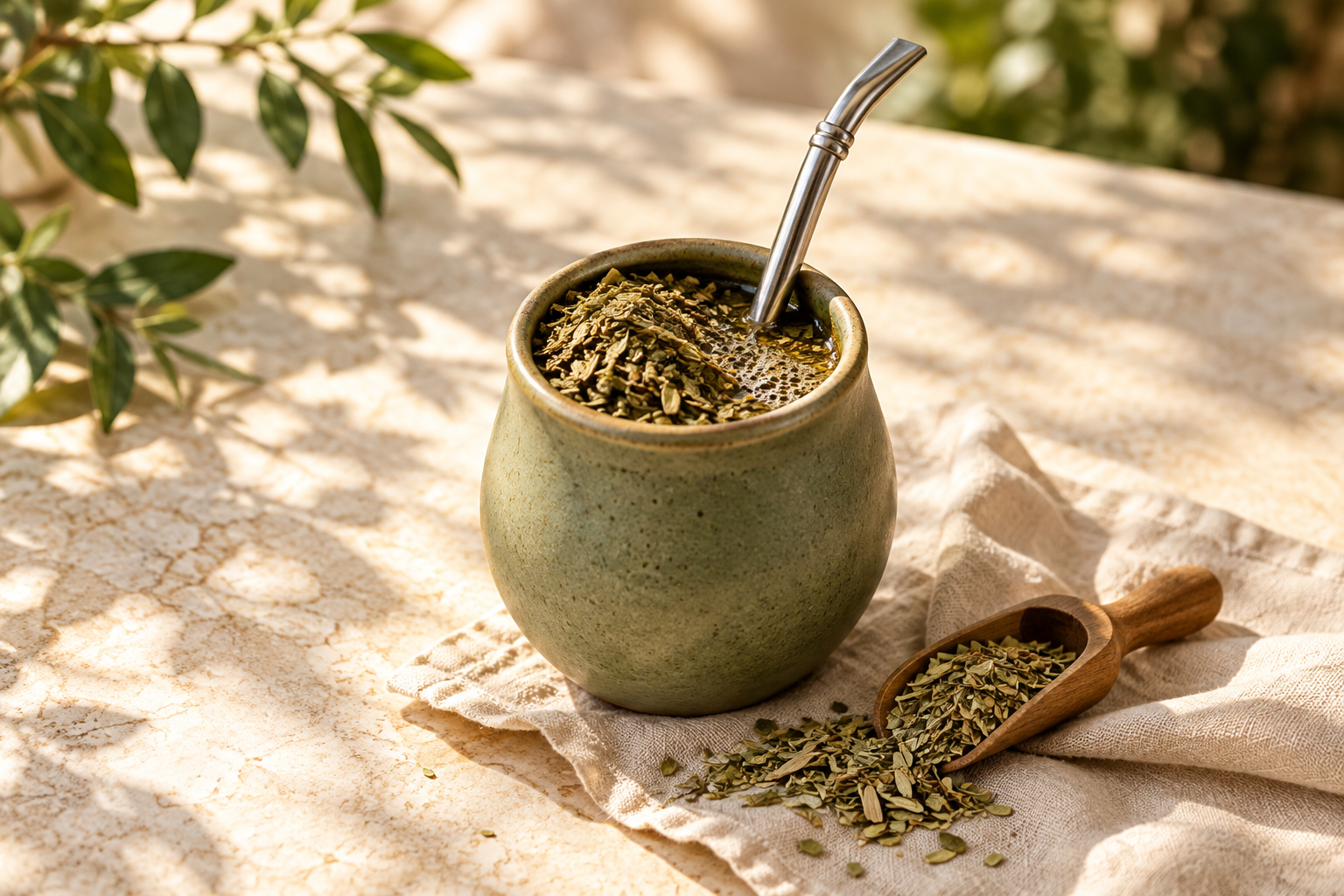
A bombilla is a drinking straw with a filter at its lower end. It lets you sip the infusion while the leaves stay in the vessel. Traditional mate is often prepared in a gourd and repeatedly topped up with water; tea-style brewing offers a straightforward alternative for an ordinary mug.
What does yerba mate taste like?
Expect a leafy, herbal flavour with some bitterness. Depending on the product and preparation, you may also notice woody, grassy or toasted notes. Some mate tastes smoky, although smokiness is not a feature of every product.
That first cup can feel quite different from a light fruit infusion. Give yourself room to adjust the strength. A smaller serving of leaves may be more enjoyable than beginning with a large, densely filled traditional vessel.
Blends offer another way in. Lemon and ginger add a bright, warming character. Peppermint brings a cooling aroma. Berries shift the emphasis towards fruit, while chai spices suit a richer drink with milk.
Choose by the flavours you already like rather than by how experienced you think a mate drinker should be. There is no requirement to begin with the strongest or most bitter option.
Yerba mate caffeine and what to expect
Yerba mate contains caffeine, but there is no single reliable amount for every cup. The quantity of leaves, the proportion of mate in a blend, water volume and brewing conditions all affect the finished drink. A small mug and a traditional vessel refilled several times are different servings.
Research comparing yerba mate brewing conditions found differences in caffeine extraction between products and infusions. Reusing the leaves does not make the next refill caffeine-free. Unless a manufacturer provides a measured value for a defined preparation, an exact milligram figure for your homemade cup would be an estimate.
Caffeine can increase alertness and reduce sleepiness, as explained by the European Food Safety Authority. Your response still depends on how much you consume and your individual sensitivity. Claims that mate always delivers energy without jitters or a crash are too definite.
If you are trying mate for the first time, prepare one modest serving earlier in the day. Count it alongside coffee, black tea, matcha and other caffeinated drinks. A floral, mint or fruit ingredient does not cancel out the caffeine in a mate blend.
Yerba mate benefits without the exaggerated promises
The practical appeal of mate is easy to understand. It offers a distinctive flavour, several preparation styles and a way to vary your usual hot drinks. Brewing it yourself also lets you decide whether to add sugar, honey or milk.
Yerba mate contains plant compounds including polyphenols. Laboratory research measures these compounds and their antioxidant activity, but those measurements are not proof that a particular cup prevents disease. Drinking mate should not be presented as a treatment or a guaranteed route to weight loss.
Choose it because you enjoy the taste and the ritual. If you usually drink sweetened beverages, an unsweetened infusion gives you another option; adding syrup or sweetened milk will change what is in your glass. A product name containing words such as “detox” is not, by itself, evidence of a detoxifying effect.
Which yerba mate tea should you try?
Start with your preferred flavour and how you plan to prepare it. These options from Leaf & Spice cover a useful range, from convenient tea bags to loose blends for iced drinks and lattes.
Lemon and ginger for a bright first cup
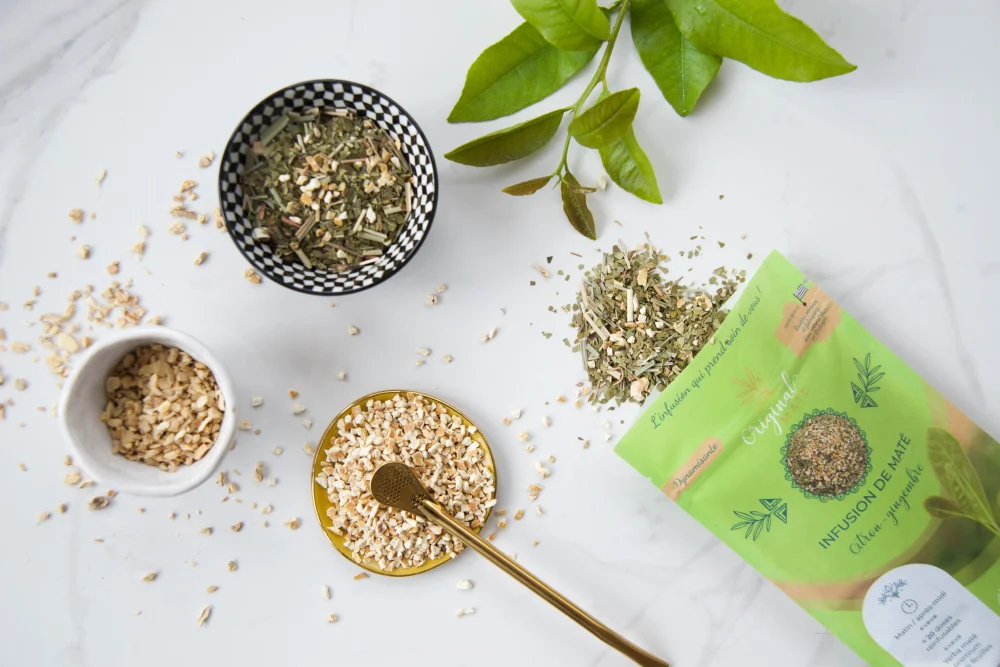
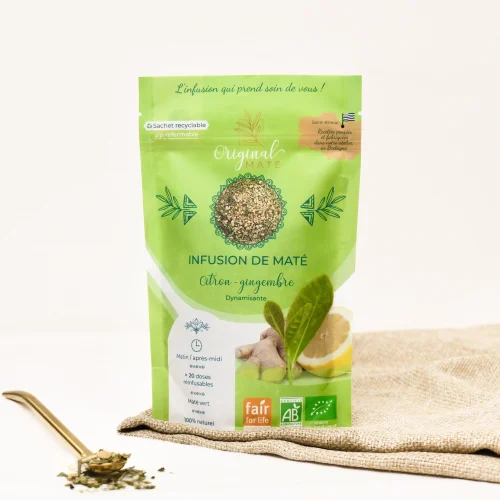
Original Mate Organic Lemon & Ginger Yerba Mate, 70 g combines green mate with lemongrass, lemon peel, ginger and natural lime flavour.
This would be our starting suggestion for someone who already enjoys citrus teas. It gives you familiar flavours alongside the character of mate, and the combination is easy to imagine as either a warm morning drink or an iced afternoon glass.
Try it plain first. If you want more citrus, add a small strip of lemon peel to the finished cup and taste again before adding a sweetener.
View this blend
Peppermint for a cooling herbal flavour
Original Mate Organic Peppermint Yerba Mate, 70 g pairs green mate with peppermint leaves, natural peppermint flavour and marigold flowers.
Choose it if you like a pronounced mint aroma. Our serving suggestion is to brew it according to the packet, let it cool, and pour it over ice with a fresh mint sprig. Keep the garnish simple so the peppermint remains the main flavour.
Remember that peppermint mate differs from a plain peppermint infusion: the mate component means it contains caffeine.
View this blend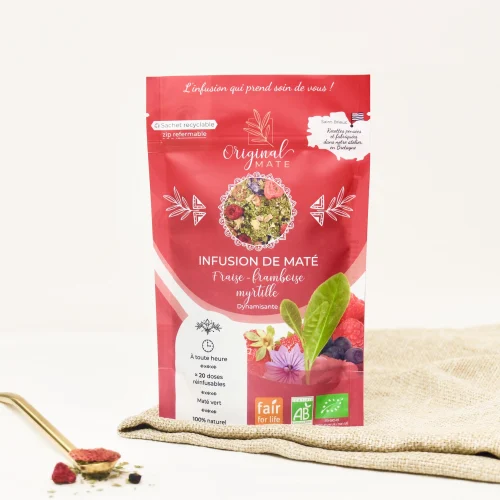
Berries for a fruity introduction
Original Mate Organic Strawberry, Raspberry & Blueberry Yerba Mate, 70 g contains green mate, real berry pieces and natural strawberry flavour.
It is a good option to consider if fruit teas are already your favourite. The berry character gives you a familiar starting point while leaving room to discover mate’s herbal base.
For serving, try a chilled glass with a few sliced strawberries. A fruity aroma does not necessarily mean a sugary drink, so taste the infusion before deciding whether it needs anything else.
View this blend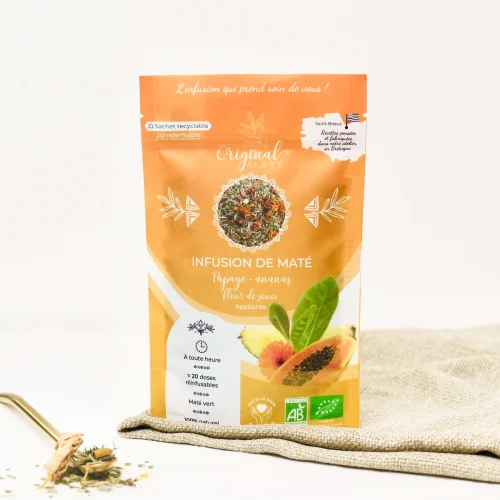
Papaya and pineapple for a tropical variation
Original Mate Organic Papaya & Pineapple Yerba Mate, 70 g combines mate with lemongrass, papaya, pineapple, natural pineapple flavour and marigold flowers.
Consider this blend if you tend to choose tropical fruit flavours. It is an appealing candidate for an iced mate with a lime wedge, especially when you want a change from familiar peach or lemon iced tea.
Keep any added juice to a small splash at first. Too much can hide the flavour of the infusion you have just brewed.
View this blend
Cinnamon and cardamom for a warming chai
Original Mate Organic Chai Yerba Mate, 80 g combines green mate with cinnamon, ginger, cardamom and natural vanilla flavour.
Choose it if you enjoy fragrant chai spices. Brew and strain it according to the packet, then try a little warm milk if you prefer a creamier cup. Start with a small splash so the spices remain easy to taste.
This is a loose-leaf infusion, so it needs brewing rather than dissolving like an instant latte powder.
View this blend
Ginger and lemon tea bags for convenience
Organic Ginger Lemon Yerba Mate Tea, 16 Tea Bags combines mate with ginger, hibiscus, lemon, lime and black pepper.
Tea bags make sense if you want a simple first purchase for work or do not want to measure loose leaves. This blend has its own preparation instructions, including a hotter temperature and longer steep than the Original Mate loose-leaf products. Follow its packet rather than using a universal mate recipe.
View this blendHow to brew yerba mate in a mug
Making yerba mate with a filter is the easiest way to learn which strength you enjoy. Use a fine filter that can hold the smaller particles, and leave enough room for water to circulate around the blend.
For the Original Mate Lemon & Ginger blend, the listed tea-style method is approximately one tablespoon per 300 ml of water, at no more than 80°C, infused for at least five minutes. Its product guidance also suggests approximately 2–5 g for a milder serving. A spoonful’s weight varies with the blend, so weighing is more useful when you want to repeat a cup precisely.
- Read the packet for the product’s dose, temperature and infusion time.
- Place the measured blend in your filter or infuser.
- Add water at the recommended temperature and set a timer.
- Remove the filter or strain the infusion when the time is up.
- Let it cool to a comfortable drinking temperature, then taste.
If the flavour is too strong, dilute the finished cup with a little water. On your next brew, change one thing, such as the amount of leaves, so you can tell what helped. If it is weak, increase the dose slightly within the product’s guidance before resorting to a very long steep.
Brewing the ginger and lemon tea bags
The listed instructions for Organic Ginger Lemon Yerba Mate Tea are one bag in approximately 200 ml of water at 95–100°C, steeped for 6–8 minutes. Remove the bag and let the drink cool before sipping.
This difference matters. A blended herbal tea bag and a loose green mate blend may be designed for different methods. The packet is the best starting point for the product in your hand.
How to prepare traditional mate with a bombilla
Traditional mate uses a larger quantity of leaves and repeated small additions of water. The Argentine National Institute of Yerba Mate’s preparation guide describes the following approach:
- Fill the mate vessel roughly three-quarters full with suitable yerba.
- Cover the opening, gently shake, then tilt so the leaves form a slope.
- Add a little lukewarm water to the lower side and allow it to soak in.
- Insert the bombilla into that damp area and leave it in place.
- Pour small amounts of water at around 75–80°C beside the bombilla, keeping some of the upper leaves dry.
- Refill that area as you drink, stopping when the flavour is exhausted.
This describes a traditional method, not the required serving size for every flavoured blend. Follow a blend’s own instructions when they differ. A large vessel filled with leaves can also give you much more mate over a session than a single tea-style mug.
How to make iced yerba mate
The simplest iced version starts with a hot infusion prepared according to its packet. After straining, let it cool, then serve over ice. This works well when you want to use the same product for both warm and cold drinks.
For a first glass, choose the lemon-and-ginger, peppermint or berry blend above. Try it chilled without additions, then decide whether you prefer a citrus slice, fresh mint or a little fruit.
A simple citrus iced mate serving idea
Prepare one serving of a citrus mate blend using its recommended method. Strain and cool it, then pour it into a glass with ice. Add a thin slice of lemon or lime. Taste before sweetening; if needed, stir a small amount of honey into the infusion while it is still warm so it dissolves evenly.
Ice will dilute the drink. If the first attempt is too light, use slightly less brewing water next time while keeping the packet’s temperature and infusion time. Avoid compensating by leaving the leaves in indefinitely.
Traditional tereré has its own cultural context and preparation practices involving cold water. UNESCO recognises the traditional knowledge and practices of tereré in Paraguay. A hot-brewed mate poured over ice is a convenient iced drink, but it does not reproduce that entire tradition.
How to make a yerba mate latte
A spiced mate blend is a useful place to start because the aromatic ingredients give the milk something to work with. The Original Mate Organic Spiced Chai Yerba Mate Latte product lists this method for approximately 300 ml:
- Add one tablespoon of the blend to an infuser or teapot.
- Pour over about 75 ml of water at no more than 80°C.
- Infuse for three minutes.
- Add approximately 225 ml of warm plant-based milk and infuse for another two minutes or longer.
- Strain before serving and allow to cool as needed.
This latte blend contains a salted-butter caramel component. Check the pack’s allergen information; adding a plant-based drink does not automatically make the complete recipe dairy-free.
For more drink ideas, explore the tea latte collection or read our guide to making tea lattes at home.
Yerba mate compared with coffee and matcha
Mate, coffee and matcha all offer caffeinated drink options, but the experience of making and drinking them is different. Your preferred taste and routine are often more useful deciding factors than looking for an overall winner.
| Drink | Typical flavour | Preparation | A reason to choose it |
|---|---|---|---|
| Yerba mate | Herbal and earthy, with some bitterness | Infused and filtered, or sipped through a bombilla | You enjoy herbal flavours and want to try different blends |
| Coffee | Roasted, with acidity and bitterness that vary by coffee | Brewed from ground beans | You enjoy a roasted aroma and an established coffee routine |
| Matcha | Green and vegetal, often with umami | Powder whisked into water | You enjoy a fuller texture or whisked tea latte |
Serving size and preparation affect caffeine in all three, so mate should not automatically be treated as the lower-caffeine choice. If the whisked green-tea style appeals to you, browse our matcha tea collection.
Common yerba mate brewing mistakes
Starting stronger than you enjoy
An intense first cup can put you off before you find a preparation you like. Begin with the product’s milder option where one is given. You can increase the strength after you understand the flavour.
Treating every product the same
Use the instructions for your exact blend. A recipe for a traditional gourd, an Original Mate loose infusion and a herbal mate tea bag may use different quantities, temperatures and steeping times.
Leaving the leaves in the mug
When brewing tea-style, remove or strain the leaves at the recommended time. An infuser left in the cup continues to change the drink as you sip. A removable filter makes the result easier to control.
Adding several extras before tasting
Lemon, mint, honey and milk each change the balance. Start with the infusion on its own, then make one addition. You will learn more about what suits the blend and avoid hiding its character.
Confusing brewing temperature with drinking temperature
Water hot enough for brewing may still be too hot to sip. The International Agency for Research on Cancer identifies drinking very hot beverages, above 65°C, as a probable cancer hazard. Let mate cool before drinking; this temperature concern also applies to other hot beverages.
Drinking yerba mate thoughtfully
Consider your total caffeine intake and how you feel after drinking it. EFSA’s general guidance identifies up to 200 mg in a single dose and up to 400 mg across a day as levels that do not raise safety concerns for healthy adults, with a lower daily level of 200 mg during pregnancy. These are not targets, and they cannot be converted into a fixed number of mate cups without knowing the caffeine in those servings.
If you are pregnant, breastfeeding, sensitive to caffeine, taking medication or managing a condition affected by caffeine, ask a qualified healthcare professional about whether mate fits your circumstances. Avoid assuming a naturally sourced stimulant will suit everyone.
Frequently asked questions about yerba mate tea
Can I make yerba mate without a gourd?
Yes. Use a mug with a suitable filter or brew in a teapot and strain. Tea bags are another simple option. A gourd and bombilla are useful for exploring traditional preparation, but you do not need them for your first cup.
Is yerba mate the same as green tea?
No. Yerba mate comes from Ilex paraguariensis, while green tea comes from Camellia sinensis. Both can taste green or vegetal and contain caffeine, but they are different plants with different preparation traditions.
Can I reuse yerba mate leaves?
Many mate products are suitable for more than one infusion. The Original Mate berry blend, for example, lists two or three reinfusions. The flavour changes as the leaves are used, and subsequent servings still contain caffeine. Follow the product’s guidance and stop when you no longer enjoy the taste.
Can I drink yerba mate in the evening?
Because mate contains caffeine, it may interfere with sleep. Earlier in the day is a more sensible starting point if you are unsure how you respond. A mate blend with calming-sounding ingredients such as lavender still needs to be considered a caffeinated drink.
Which yerba mate is best for beginners?
Begin with a flavour you recognise. Lemon and ginger is our suggestion for citrus-tea drinkers, peppermint suits mint lovers, and a berry blend is worth considering if you prefer fruity infusions. Tea bags are convenient if equipment and measuring would otherwise stop you trying it.
How should I store loose yerba mate?
Reseal the pack after opening and keep it somewhere cool and dry, away from light, steam and strong food aromas. Use a clean, dry spoon and follow the date and storage instructions on the packaging.
Find your first yerba mate at Leaf & Spice
Choose one blend and make a small first serving. Taste it warm, notice what you like, and adjust the next cup. If citrus is your usual choice, start with lemon and ginger; if you prefer a creamy spiced drink, try the chai latte blend.
Explore the Leaf & Spice yerba mate collection to compare ingredients, pack sizes and preparation instructions, and find a flavour you look forward to brewing again.